The hidden dependency
When we talk about the semiconductor technology gap between China and Taiwan, the discussion normally focuses on companies such as TSMC, SMIC or ASML. But one of the most intriguing bottlenecks sits much further upstream in the supply chain, namely in Germany.
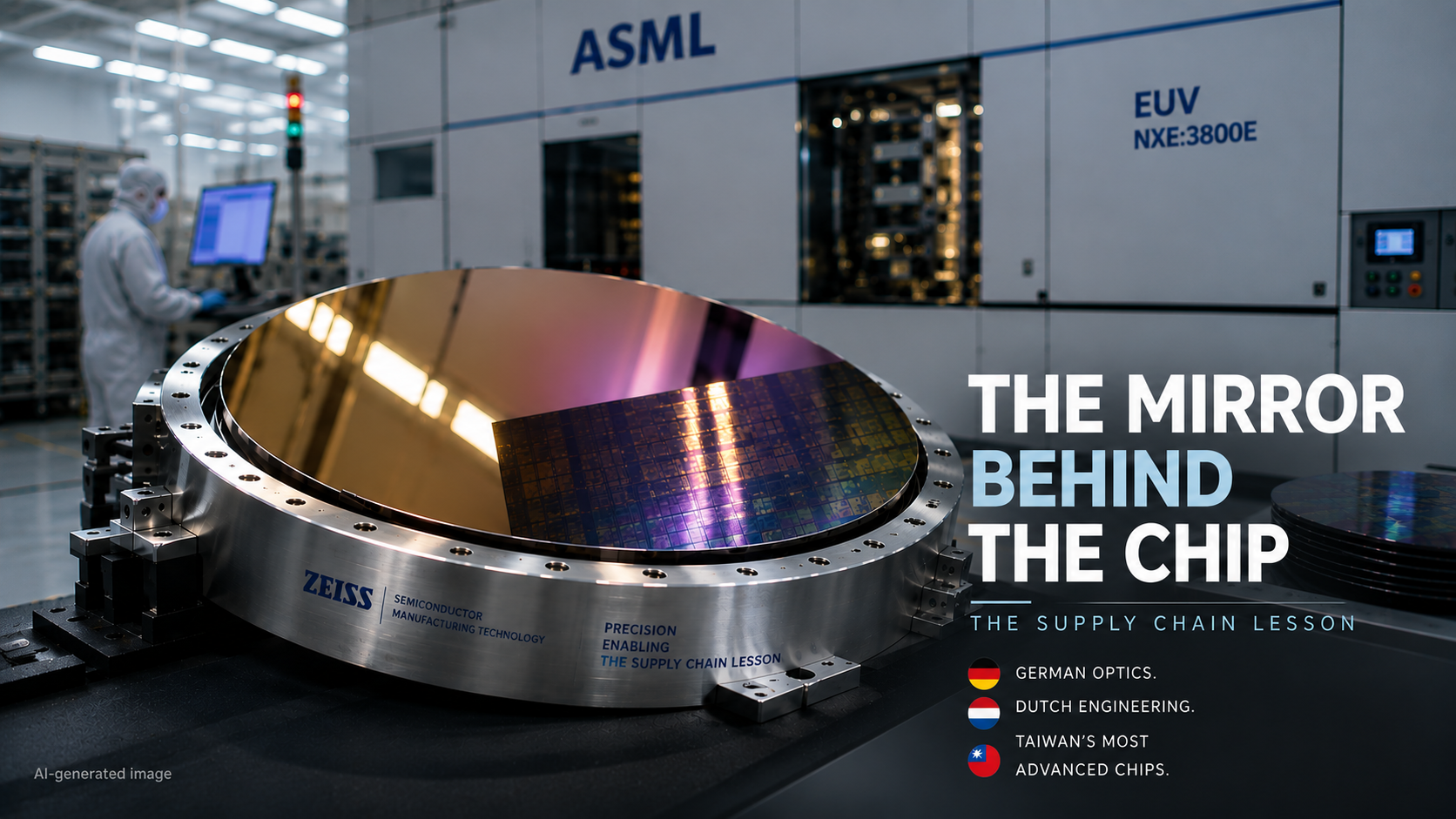
TSMC uses ASML's EUV lithography systems to manufacture its most innovative chips. And inside those machines is an optical system made by ZEISS Semiconductor Manufacturing Technology. This is where things become intriguing from a supply chain perspective.
EUV cannot use conventional lenses. Modern EUV lithography operates with light at a wavelength of just 13.5 nanometers. At this wavelength, conventional optical lenses do not work because EUV radiation is absorbed by almost every material, even air.
So instead of lenses an EUV scanner uses extremely precise multilayer mirrors operating inside a vacuum. Each mirror contains more than 100 engineered material layers. And their surface and positioning accuracy have to be controlled at a scale approaching fractions of a nanometer.
Why these mirrors are so difficult to make and why China cannot simply replace them
ZEISS has spent decades developing this capability together with ASML. Reproducing such technology is extremely difficult for China. But the problem is bigger than a mirror. It would be incorrect to say that China cannot compete with TSMC simply because it does not have ZEISS mirrors. EUV lithography is an entire scientific ecosystem.
A commercially usable scanner needs a powerful EUV source, collector optics, illumination and projection optics, ultra precise wafer stages, masks, metrology, computational lithography and very sophisticated process control. And all of these systems need to work together with substantial throughput, reliability and yield.
China has already demonstrated that innovative chips can be produced without EUV. SMIC has used DUV lithography combined with complex multipatterning techniques to manufacture 7 nm class chips. But this affects the price: more process steps, higher complexity, long cycle times and generally lower economic efficiency.
China is rebuilding the lithography supply chain
One of the most important Chinese research centers in this field is the Changchun Institute of Optics, Fine Mechanics and Physics (CIOMP). It has been working on EUV and X-ray optics since the 1990s, including ultrasmooth polishing, multilayer coatings and EUV projection optics.
Commercial Chinese companies such as Beijing Guowang Optics and Changchun Guoke Precision are also developing lithography optical systems. However, public data still does not indicate that any Chinese supplier is capable of producing EUV projection optics on the industrial scale achieved by ZEISS. That gap is still significant.
At the same time the progress in the Chinese lithography ecosystem is accelerating. In 2025, China reportedly completed a prototype EUV system in Shenzhen capable of generating 13.5 nm EUV light. It cannot yet manufacture usable chips and precision optics remain one of the major challenges. But the existence of such a prototype changes the discussion. In 2026, China started producing its first domestically developed immersion DUV lithography systems.
A separate EUV development program associated with SiCarrier is underway under the domestic name "Mount Everest". China is therefore not trying to replace an ASML machine. It is trying to recreate an entire supply chain.
The supply chain lesson
This story illustrates something we often underestimate in procurement: A technology can depend on a component produced by a supplier several tiers upstream that most people have never heard of.
TSMC's competitive advantage is not created by TSMC alone. There is ASML and there is ZEISS behind TSMC. Behind ZEISS stands another ecosystem of coating technologies, optical materials, precision manufacturing equipment, metrology and specialized suppliers accumulated over decades.
That is why supply chain resilience cannot be evaluated only by counting direct suppliers. Sometimes the real strategic dependency is hidden three or four tiers upstream. And replacing it is not a sourcing project. It is an industrial development project spanning decades, which very often depends on government support and industrial policy.
Originally published on LinkedIn.
Back to Selected Insights ↗